It is very timely, as I explore this topic, that my own son was featured in the newspaper this week on the very topic of incorporating technology into the classroom. I have 6 year old twin boys who are non verbal and attending a special development school. Their entire class is non verbal, so there is a big focus on using Augmentative and Alternative Communication, commonly known as AAC. There are a number of ways to incorporate AAC into the classroom, but one of the main ways is via using an app on an Ipad or dedicated communication tablet. These apps not only give students a mode to communicate, but their learning experience can be greatly enhanced by incorporating this form of communication into learning activities, such as exploring a book, a song, following a recipe or instructions, and interacting in group activities they could never fully participate in before. I have posted the link to the article below, however it may not be accessible without a free subscription to The Guardian.
Giving Voice to Non-Verbal Through Apps
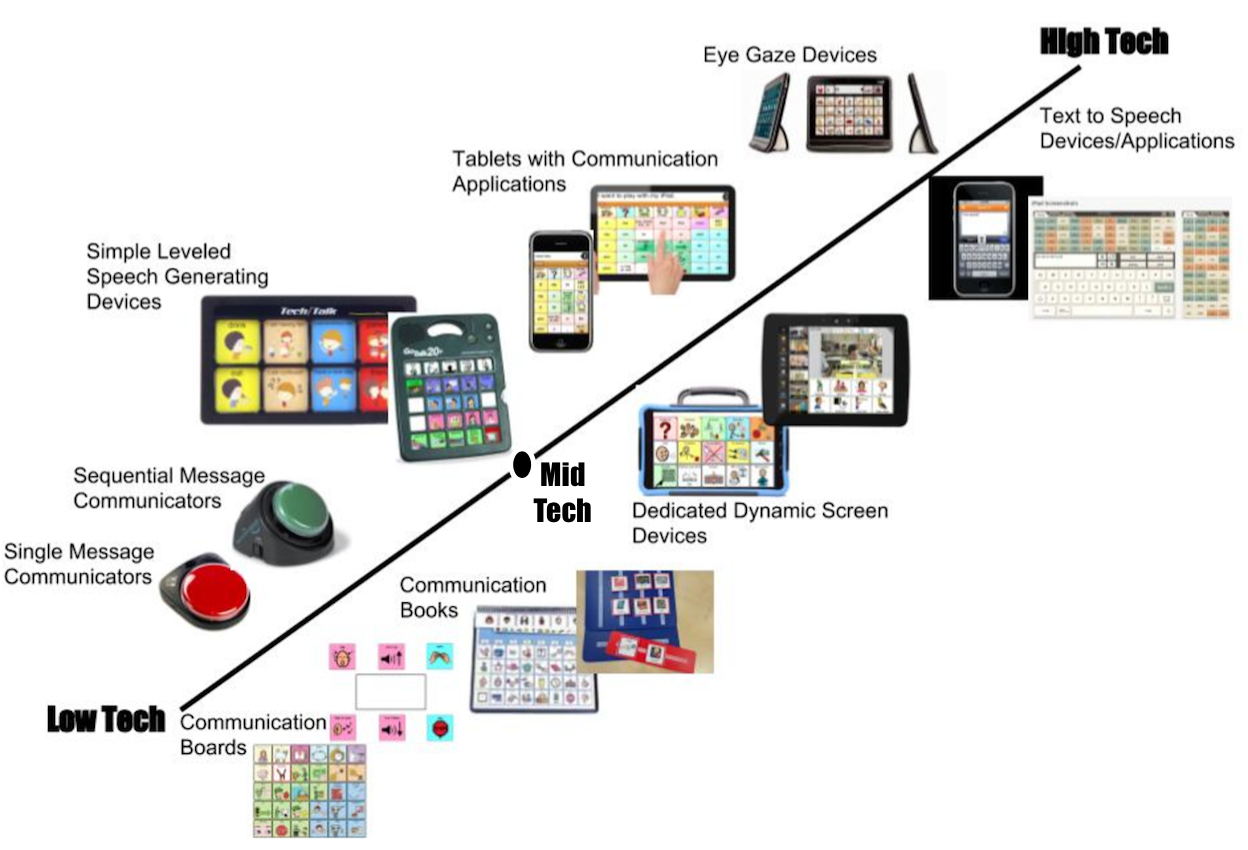
Resources used for AAC in the classroom range from low tech binders of laminated cards known as PECS and printed communication boards, through to push button audio devices where you push on an image to hear the audio and advance through to high tech Ipad apps, some of which can even be controlled by simple eye movements for children with physical impairments. My children’s school has a giant AAC communication board in the playground to allow children to access easy communication during outdoor play and lessons.
Image via Integrated-Assistive Technology Services
Ledford says there are a number of factors for educators to consider when deciding which form of AAC to use in their classroom and in specific lesson scenarios and while keeping in minds the needs of each individual student.
- The first thing to consider is the capabilities of the student, what limitations do they have physically and cognitively. Larger icons and buttons for children with visual impairments or impaired fine motor skills, eye gaze capabilities for children who are unable to use their fingers to tap icons. Ledford explains that some children have difficulty discriminating between multiple images and so need to have some extra assistance in learning this skill.
- The second thing to consider is the availability of the device, for AAC to work effectively, each individual communicator needs to have immediate access to their means of communication at all times. For example, in my children’s class, up until now, some children have their own devices, some do not, sometimes a parent, AKA me, forgets to charge the device overnight or a device gets left at home. With help from State Schools Relief, my children’s classroom have now been given a class set of Ipads strictly for AAC use that will be available to the children for every moment of their school day. This will be a huge step to ensuring this technology can easily be incorporated into every lesson plan. It also ensures that every child in the class is using the same AAC app and symbol set, which helps classroom communication and lessons to to run more smoothly and consistently.
- The third thing to consider is to ensure that every staff member involved with working with the students has training and in depth understanding of the importance of AAC and how to implement it’s use in their daily lessons and interactions with the children. Professional development is imperative in this area. Educators and therapists should be up to date in their knowledge of all forms of AAC communication being used by each child.
Ledford says that according to the Autism Association of Western Australia, the best way for a child to gain competence and fluency in communicating with their device is to incorporate it into all activities, even when the focus of that lesson is not on expressive language. Using AAC to communicate requests such as “more” or to signify “finish” at the end of a story or song, to describe, request or choose items and colours in an an art activity, to describe what happened in a story by selecting action words or characters or to request further information from the teacher or other students. The device should be use to elicit responses from others, rather than a one way system. Pair work should encourage verbal children to use AAC with their non verbal peers to encourage interaction.
Basic learning goals such as the alphabet and learning to read and write are a high a priority for non verbal children, these additional communication skills will be an asset for their future interactions and study. It is imperative therefore that the AAC tech being used has easy access to alpha and numeric characters as well as single words.
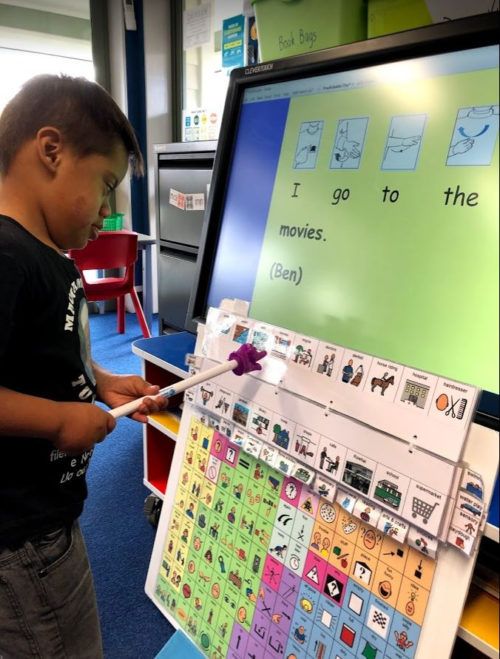
Check out this example from the AAC Language Lab to see how an AAC device can be incorporated into a multi faceted lesson plan in either a mainstream or special needs classroom.
Image by Angi Pearce via Praactical AAC
Speech Pathologist Vicky Clarke has developed a number of helpful charts to assist teachers to plan inclusive lessons for non verbal students, ensuring that their learning aligns with their communication and IEP goals while at the same time enhancing their educational experience. There is an emphasis on ensuring each student has adequate communication skills to align with what is required from an activity, and also to ensure teachers, students and their classmates are fully equipped and prepared for each lesson.
You can learn more about this in the linked video below.
Resources
- AAC Language Lab Play That Music https://aaclanguagelab.com/lesson-plans/play-that-music?mode=pdf
- Clarke, Vicky featured by Zangari, Carole. (2021, November). AAC in School: Classroom Communication Goals Grid Praactical AAC Blog https://praacticalaac.org/praactical/aac-in-school-classroom-communication-goals-grid-revised/
- Clarke, Vicky. (2021, October 5) Classroom Communication Goals Grid Intro . YouTube. https://www.youtube.com/watch?v=4lMP6CV0PVk&ab_channel=VickiClarke%26AACChicksatDTASchools
- Integrated-Assistive Technology Services AAC Continuum [photo] https://sites.google.com/a/nssed.org/nssedintegratedtech/resources/communication/aac-continuum
- Ledford, Jennifer. Augmentative and Alternative Communication (AAC) Evidence Based Instructional Practices for Young Children with Autism & Other Disabilities
- Pearce, Angie (2021). Picture of child using communication board [photo] https://praacticalaac.org/praactical/aac-in-school-classroom-communication-goals-grid-revised/
- Spicer, Nathan. (2022, July 29) ‘Giving Voice to the Non-Verbal Through Apps’ The Guardian https://www.theguardian.com.au/education/giving-voice-to-non-verbal-through-apps?fbclid=IwAR2hCWkRn4N_TwAmPOeLzPvGrZsvjKyXkzZibSEvj4jxPe1U65ccdYEp1iU
 Educating Gen Alpha